Dec 15, 2023
Avoid sending spam for better email deliverability
In the past month, the average number of spam emails sent daily was a staggering 250 billion, as reported by Cisco's SenderBase. This indicates that spam emails make …

Table of Contents
In today's world of digital communication, email remains a cornerstone of personal and professional communication. But as emails evolve, so do the threats associated with them. Email spoofing and phishing attacks are becoming increasingly sophisticated, posing significant user risks. To strengthen its security and ensure the safety of its users, Gmail or sometimes referred to as “Google Mail”, a leader in email services, has taken strong measures to reject unauthenticated emails. This article explores Gmail’s vigilant stance on unverified email and how it enhances email security.
Email authentication is essential in ensuring that email communications are reliable and secure. It verifies that the sender is indeed who they claim to be, not an imposter attempting malicious activities. Gmail successfully demonstrates these authentication schemes to protect its users. SPF (Sender Policy Framework) and DKIM (DomainKeys Identified Mail) are essential features. SPF allows the domain owner to specify which host is authorized to send it, while DKIM signs the email with a digital signature, verifying its authenticity. The importance of these verification methods cannot be overstated. Using this technology, Gmail can segment real emails from different web browsers, making email communication a safer experience for users. It’s a strategic move that underscores Gmail’s goal of ensuring reliable emails users receive.
With email-based cyber threats on the rise, Gmail has taken a firm stand against unverified emails. When email authentication fails, Gmail reacts swiftly, denying delivery to the recipient’s inbox, and this is a robust defence mechanism. By rejecting such emails, Gmail significantly reduces the risk of phishing attempts, spamming and other malicious activity. Gmail’s unauthenticated email rejection acts as a safety shield for users, ensuring that only authenticated emails reach their inboxes. This commitment to email security demonstrates Gmail’s proactive approach to protecting its user base.
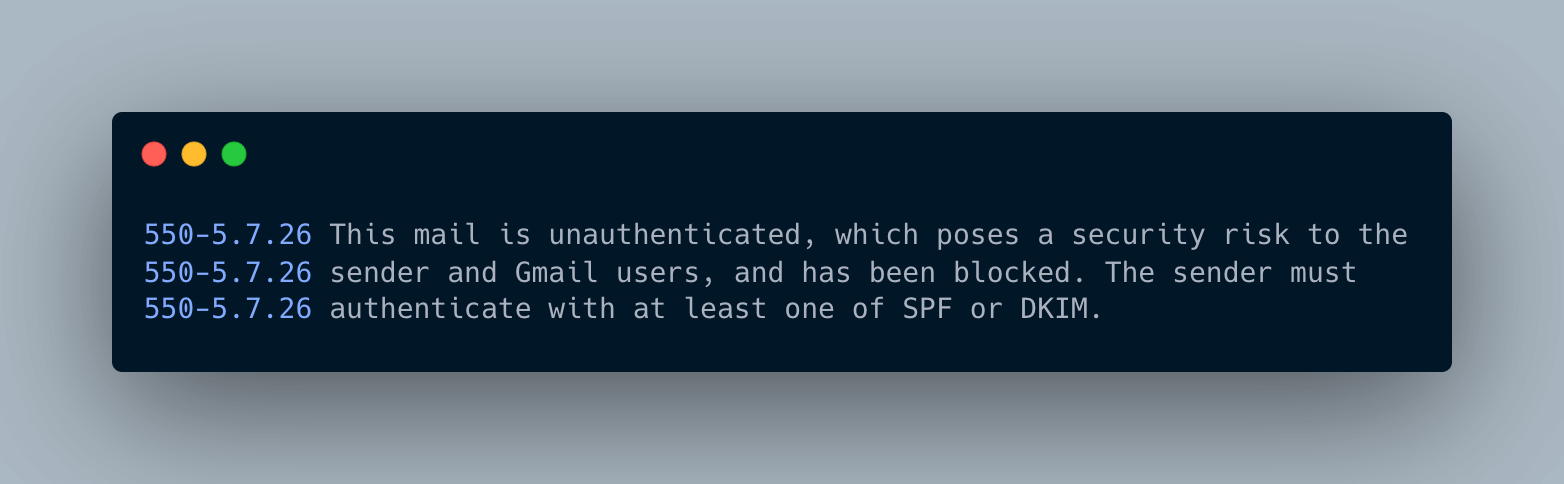
Gmail’s authentication denial policies for legitimate email senders highlight the need for proper email practices. It encourages senders to use verification programs to verify the authenticity of their emails, thereby increasing the chances of successful email delivery. By following these best practices, senders can ensure their messages are not mistakenly flagged as suspicious or rejected.
The following are some of the common reasons for email authentication failures and the preventive measures for them.
Misconfiguring SPF and DKIM records is a common reason for email authentication failure. Improper setup of these records can result in emails failing the authentication checks.
Example:
If domain owners forget to include all authorized sending IP addresses in their SPF record, emails from an unlisted IP will fail SPF authentication.
Prevention:
Regularly review and update SPF and DKIM records to ensure all authorized sending sources are included, reducing the risk of misconfiguration.
An incorrect or poorly configured Domain Name System (DNS) can cause authentication failure. DNS is crucial for SPF and DKIM to function accurately.
Example:
If the DNS is not updated with the DKIM public key, the email server won’t be able to authenticate emails signed with DKIM.
Prevention:
Always verify that DNS records, especially those related to SPF and DKIM, are accurately configured and up to date.
Emails forwarded or relayed through other servers can break authentication, leading to SPF or DKIM failures.
Example:
An email forwarded through an unauthorized server might not pass SPF authentication.
Prevention:
Minimize email forwarding or relay through authorized servers to ensure proper authentication.
Gmail’s tough stance also requires organizations to prioritize email security. Companies must educate their teams on email authentication procedures and adopt email security solutions that meet industry standards. In the long run, this benefits both senders and recipients, creating a more secure email environment.
Gmail’s decision on email authentication sets a precedent for the email industry. As cyber threats continue to grow, the emphasis on authentication and email security will increase. Gmail’s commitment to user safety reinforces the importance of collective efforts to ensure a secure email ecosystem.
Gmail’s proactive measures will likely inspire other email service providers to follow suit. A more secure email environment is an aspiration and a must in our digitally connected world. Gmail’s dedication to rejecting unauthenticated emails signals a promising trajectory for the future of email security.
Gmail’s unwavering focus on rejecting unverified emails proves its commitment to user security in a world of increasingly visible cyber threats. By leveraging robust email authentication mechanisms and stringent rejection policies, Gmail is tightening security for its massive user base. This move is not only a security measure for today but a catalyst for creating a more secure email landscape for the future.
I am a Blogger, Writer, Consultant and a Teacher. I work under Jonah NZ. I love travelling, meeting new people and exploring new places. I am a big fan of AI and new technology, and I am also a big car enthusiast.
In the past month, the average number of spam emails sent daily was a staggering 250 billion, as reported by Cisco's SenderBase. This indicates that spam emails make …
Cold emailing involves sending spontaneous emails to potential clients or business contacts to create new opportunities. In today's digital age, it's a vital skill …
Maintaining a positive sender reputation can be challenging. Several factors contribute to how email providers perceive a sender. Add subscribers using disposable …
Big news for email senders. Google has set to implement some changes that impact a lot of senders – those they call “bulk senders.“ If you're sending 5,000 or more …

Cold emailing serves as a proven and reliable method to boost outreach and conversion rates, making it a valuable marketing strategy for business growth—however, …

Would ‘The Great Gmail Purge‘ affect your email marketing efforts? No need to worry if you prepare ahead of time! Effective preparation ensures your emails …